Would the Torah approve of AI?
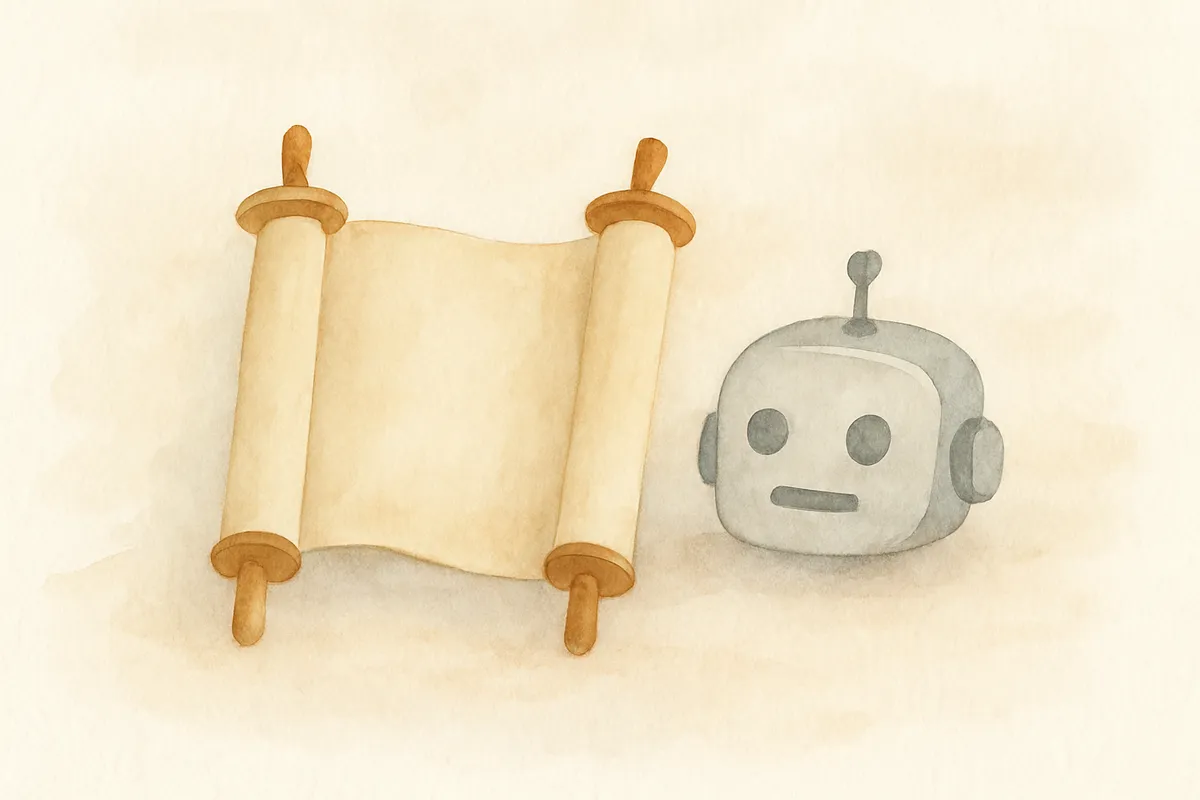
Artificial intelligence doesn't appear in the Torah explicitly, but Jewish tradition offers rich frameworks for evaluating transformative technologies. The Torah would neither wholesale approve nor condemn AI — rather, it would demand that AI be developed and used in accordance with core values: tzelem Elohim (the divine image), human dignity, ethical responsibility, and the preservation of meaning in human life.
Key Takeaways
- The Torah's concern is not technology itself, but its ethical use and whether it preserves or undermines human dignity and divine values.
- AI raises unique questions about the nature of human uniqueness (tzelem Elohim), similar to debates around cloning and other advanced biotechnologies.
- Jewish law (halacha) has always adapted to new technologies while insisting that the spirit of the law — not just its letter — must be upheld.
- There is a danger that advanced technology, including AI, could hollow out the meaning behind religious and ethical obligations even while technically complying with their rules.
- The creation of artificial "intelligence" invites comparison to the Talmudic concept of the Golem, raising questions about what it means to create a being that imitates human reasoning.
The Torah's Framework for Evaluating Technology
Technology Is Not Inherently Good or Bad
Jewish tradition has never been anti-technology. The Torah records human ingenuity from the earliest chapters of Bereishit — Tuval-Cain forging metal tools [Genesis 4:22], the building of cities, and ultimately the construction of the Mishkan (Tabernacle), which required sophisticated artisanship. The question Torah asks of any technology is not can we? but should we? and how?
AI and Tzelem Elohim — The Image of God
What Makes Humans Unique?
The most fundamental Torah concern about AI is what it implies about human uniqueness. The Torah states:
"וַיִּבְרָא אֱלֹהִים אֶת־הָאָדָם בְּצַלְמוֹ" — "And God created man in His image" [Genesis 1:27]
If a machine can replicate human reasoning, language, creativity, and even emotion — what remains uniquely human? This is not merely a philosophical question; it is a theological one.
Rabbi Jonathan Sacks raises a parallel concern about cloning, noting that technologies of asexual or artificial reproduction challenge our understanding of human identity and uniqueness in ways that prior technologies did not [Covenant and Conversation, Genesis, Toldot]. The same logic applies to AI: it is not just another tool, but a technology that mimics the very faculty — sekhel (intellect/reason) — that many Jewish thinkers identify as the core of tzelem Elohim.
The Golem Precedent
A Talmudic and Kabbalistic Parallel
The closest traditional analogue to AI is the Golem — an artificial being created through mystical means. The Talmud records that Rava created a man-like being [Sanhedrin 65b], and the famous Golem of Prague attributed to the Maharal (Rabbi Judah Loew of Prague) became a cornerstone of Jewish ethical reflection on artificial creation.
Key lessons from the Golem tradition:
- Humans can create — this is an expression of imitatio Dei (imitating God).
- But human creations lack a soul (neshama) — the Golem could not speak, symbolizing the limit of human creative power.
- The creator bears responsibility for what they bring into the world.
AI, which can generate language and simulate reasoning, pushes well beyond the Golem paradigm and raises even sharper questions.
The Danger of Technology Hollowing Out Meaning
The Spirit vs. the Letter of the Law
One of the most profound Torah-based critiques of AI comes from a concern articulated in Karati Bekhol Lev on Parshat Re'eh:
"באמצעים מתוחכמים ובטכנולוגיה מתקדמת אפשר להפוך את השבת ליום חול. ייתכן שיגיעו ימים שבהם ניתן יהיה להפעיל את המכשירים כולם בעזרת כוח המחשבה ללא מגע יד אדם"
"Through sophisticated means and advanced technology it is possible to turn Shabbat into a weekday. Days may come when it will be possible to operate all devices through the power of thought, without human touch..."
The author's point is striking: even if a technology complies with the technical rules of halacha, it can violate the spirit and meaning behind those rules [Karati Bekhol Lev, Re'eh 2:11]. AI presents exactly this danger — a world where machines do our thinking, our writing, our decision-making, technically "freeing" us, but actually impoverishing the human experience that Torah seeks to elevate.
Halachic Considerations
Specific Areas Where AI Intersects Halacha
Jewish law would need to evaluate AI across many domains:
- Shabbat: Can AI systems run autonomously on Shabbat? This connects to the laws of grama (indirect causation) and amira l'nochri (asking a non-Jew to perform labor).
- Medical AI: AI in medicine raises questions of pikuach nefesh (saving life) — where AI could save lives, Torah would strongly favor its use. Rabbi J. David Bleich's analysis of artificial hearts shows that halacha adapts to accept life-saving technologies even when they radically alter our categories [Contemporary Halakhic Problems, Vol III, Chapter VIII].
- Testimony and Legal Decisions: Can AI-generated evidence be admissible in a Beit Din (rabbinical court)? Halacha requires human witnesses (eidim).
- Authorship and Truth: AI-generated content raises issues of geneivat da'at (deception) if presented as human work.
The Bottom Line
The Torah tradition would likely say: AI is a powerful tool that can serve great good or great harm — the moral weight falls entirely on those who build and use it. Like fire, like medicine, like nuclear energy — the technology itself is neutral, but the human choices surrounding it are not.
The deeper Torah concern is not whether AI is "approved," but whether humanity will use it in a way that:
- Preserves kvod habriot — human dignity
- Upholds truth (emet)
- Does not erode the meaning and intentionality that Torah demands of human life
- Keeps human beings — created in God's image — at the center
For practical halachic questions related to AI in your specific situation, consult your local rabbi or posek.
Sources
People Also Asked
Want to dig deeper?