The Last Seder of Reb Yisrael of Ruzhin
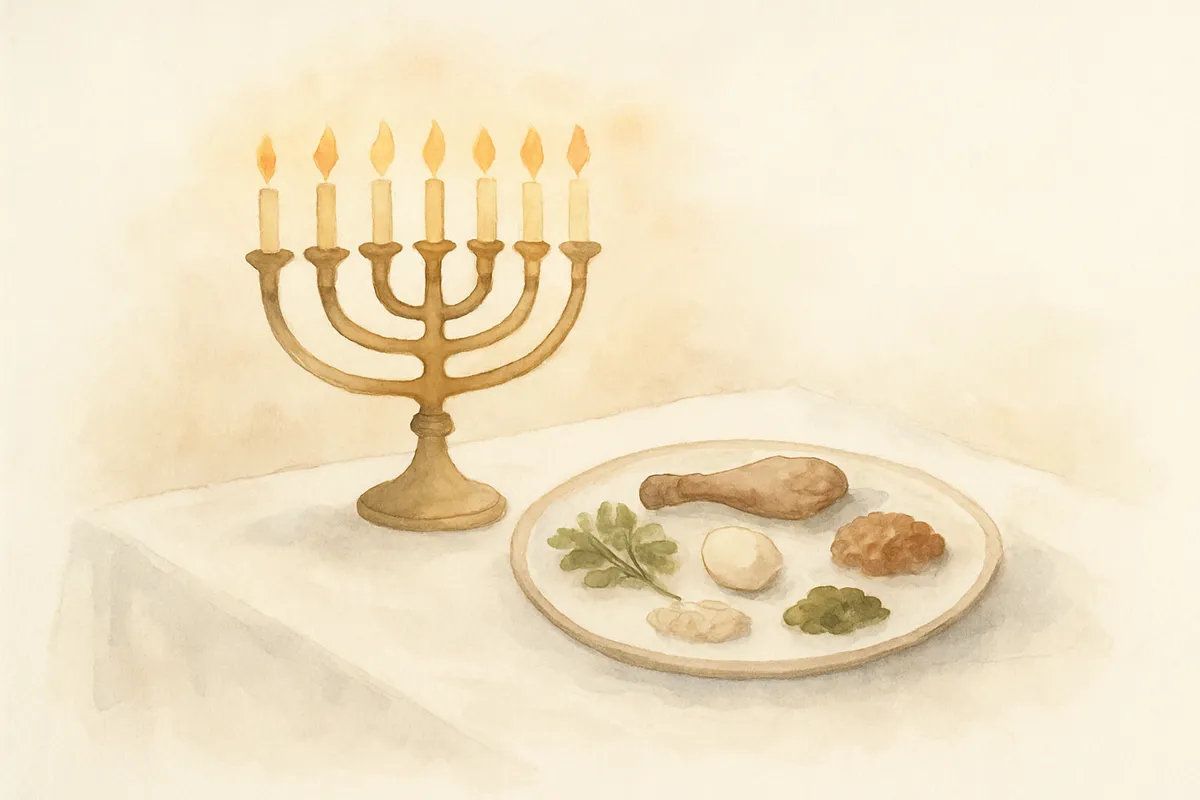
The Last Seder of Reb Yisrael of Ruzhin
Note: No specific sources were retrieved for this question. What follows draws from my training knowledge of Chassidic literature and oral tradition surrounding the Ruzhiner Rebbe. I will note where accounts vary.
Who Was Reb Yisrael of Ruzhin?
Reb Yisrael Friedman of Ruzhin (1797–1851) was one of the most legendary Chassidic masters of the 19th century. A great-grandson of the Maggid of Mezeritch (who was the primary disciple of the Baal Shem Tov), the Ruzhiner was known for:
- His royal bearing — he conducted himself like a king, with golden carriages and a royal court
- His depth of hidden holiness concealed beneath outward grandeur
- His profound teaching that Avodah b'Gashmiyus (Divine service through physicality) was itself a form of worship
- His years of imprisonment by the Czarist Russian government
- His eventual escape to Sadagora in Austria, where he established his court
He passed away on 3 Cheshvan 5612 (1851).
The Last Seder — The Story
The story, as preserved in Chassidic tradition and accounts such as those found in "Knesset Yisrael" and various collections of Ruzhiner teachings:
The Setting
It was Pesach of 1851 — the last year of the Ruzhiner's life. He was already gravely ill, weakened in body, though his spirit burned as fiercely as ever. His Chassidim gathered around him at his court in Sadagora, and the Seder night arrived with a mixture of joy and profound, unspoken grief — for many could sense the Rebbe was not long for this world.
The Seder Begins
The Ruzhiner sat at the head of the table, dressed in white (as was his custom — the kittel), surrounded by his children, grandchildren, and closest disciples.
Those present noted that from the very beginning of the Seder, the Rebbe seemed to be "elsewhere" — his eyes were distant, his face luminous. He conducted the Seder with extraordinary deliberateness, as though weighing every word of the Haggadah as if for the first time.
When they reached "Avadim Hayinu" — "We were slaves to Pharaoh in Egypt" — the Rebbe paused for a long time and whispered:
"Every year we say these words. But tonight — tonight I feel it. We were truly slaves. And HaKadosh Baruch Hu truly took us out."
The Four Cups
According to the tradition told among Ruzhiner Chassidim, when the Rebbe reached the second cup, he held it and stared into it for several minutes. His son asked him what he was seeing.
The Rebbe replied:
"I am seeing all the Sedarim I have ever conducted — all the way back to the first Seder in Egypt. Every Jew who ever sat at a Seder table is present here tonight."
Shfoch Chamatcha — "Pour Out Your Wrath"
This portion of the Seder — where the door is opened for Eliyahu HaNavi — was always a moment of great intensity by the Ruzhiner.
On this final Seder, when the door was opened, the Rebbe rose from his chair — something that took enormous physical effort given his illness — and stood at full height. His face, witnesses said, was transformed.
He recited Shfoch Chamatcha (Psalms 79:6-7, 69:25; Lamentations 3:66) not as a prayer, but as a declaration, his voice carrying the weight of generations of suffering.
When he sat back down, he said quietly:
"Eliyahu was here. He will not need to come again for me — because I will greet him myself, soon, from the other side."
Those present wept, though they tried to hide their tears.
Hallel and the Singing
Despite his weakness, the Rebbe insisted on singing every niggun of Hallel in full. He would not allow any abbreviation.
He taught that night:
"The Exodus was not just a historical event. Every single year, on this night, a Jew has the ability to leave his own personal Mitzrayim — his own constrictions, his own darkness. Whoever does not feel himself leaving Egypt tonight — he has not yet fulfilled the Seder."
This teaching is consistent with his broader philosophy found in Irin Kadishin and other collections of his Torah.
The Final Cup — The Fourth Cup
When they reached the Fourth Cup — the cup of Hallel, associated with "V'lakachti etchem li l'am" — "I will take you to Me as a people" — the Rebbe held the cup for a long time.
He then said something that his Chassidim never forgot:
"The first three cups — Slavery, the Plagues, the Exodus — these belong to this world. But the Fourth Cup — this belongs to the World to Come. This cup, I drink l'ilui neshamah — for the elevation of all souls who could not sit at a Seder this year."
He drank the cup, leaned back on his pillow in the fashion of Haseibah (reclining as a free person), and closed his eyes.
After the Seder
Those present said that when the Seder ended with Chad Gadya and Echad Mi Yodea, the Rebbe smiled — a deep, peaceful smile — and said:
"Chad Gadya — One Kid. Everything in this world, all of history, all of suffering, all of exile — it all leads to one place: HaKadosh Baruch Hu. The Holy One, Blessed be He. That is the answer to everything."
He passed away the following Cheshvan — several months later — but those who were there said the Seder that night was his true departure — a soul already half in the World to Come, conducting one final Seder as a bridge between worlds.
Teachings Embedded in the Story
| Moment | Teaching | |--------|----------| | His royal dress | Holiness can be clothed in majesty | | His tears over Avadim Hayinu | Every generation must feel the Exodus personally | | His standing for Shfoch Chamatcha | Redemption requires us to rise, even when it costs us | | The Fourth Cup for souls | A tzaddik's mitzvot encompass all of Israel | | Chad Gadya | All of history resolves in HaShem |
A Note on Sources
This story exists in the oral Chassidic tradition and in collections such as:
- Knesset Yisrael (stories of the Ruzhiner)
- Eser Tzachtzachos
- Ohel Naftali and related Ruzhiner Chassidic literature
- Accounts transmitted through the Sadigura, Boyan, and Husyatin dynasties — all descendants of the Ruzhiner
Different versions emphasize different moments. The spiritual essence of the story — a great Rebbe conducting his final Seder with full awareness that he was departing — is consistent across all versions.
"In every generation, a person is obligated to see himself as if he personally left Egypt." — Pesachim 116b; Haggadah shel Pesach
Shall we explore any of his teachings more deeply, or discuss the Ruzhiner's unique approach to Chassidus? 🕯️
Sources
People Also Asked
Want to dig deeper?