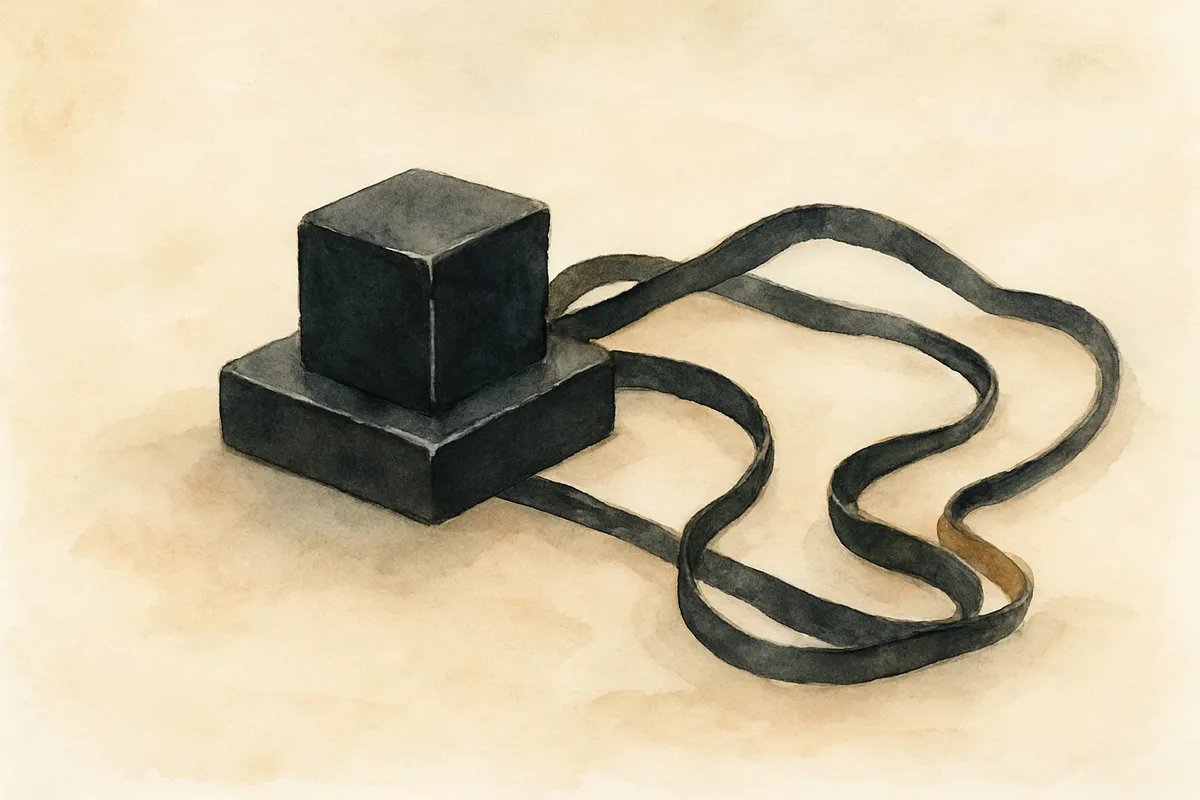
Tefillin that is Almost black
It seems your question may be incomplete — could you clarify what you'd like to know? For example, are you asking:
- Whether tefillin that has faded to "almost black" is still kosher?
- What the halachic requirement is for the color of tefillin?
- How to re-blacken tefillin that has faded?
In the meantime, here is a foundational answer on the color requirement for tefillin:
The Torah commands that tefillin be worn as a sign on the arm and between the eyes [Exodus 13:9, 13:16; Deuteronomy 6:8]. The Oral Torah (halacha l'Moshe miSinai) — law transmitted to Moses at Sinai — specifies that the batim (housings) and retzu'ot (straps) of tefillin must be completely black.
Key Takeaways
- The requirement for tefillin to be black is a halacha l'Moshe miSinai — an oral law from Sinai, not derived from the biblical text alone.
- This applies to both the batim (boxes) and the retzu'ot (straps).
- Tefillin that has faded to "almost black" may be invalid (pasul) and requires attention.
- The straps must be black on the outer side specifically.
- Re-inking faded tefillin is permitted and common practice.
The Halachic Requirement for Black
Source in Halacha
The requirement for tefillin to be black is codified in Shulchan Aruch, Orach Chaim 33:3:
"The straps must be black — this is a halacha l'Moshe miSinai."
Rashi [Menachot 35a] confirms that this blackness requirement applies to the outer surface of the retzu'ot (straps). The batim (boxes) must also be entirely black according to most poskim (halachic decisors).
Does "Almost Black" Invalidate the Tefillin?
This is where the practical question becomes important:
-
Straps (Retzu'ot): If the outer side has faded so that it is no longer truly black — even if it is a very dark brown or dark grey — this is a serious halachic problem. The Mishna Berura (33:9) rules that one should not recite a beracha (blessing) over such tefillin until they are re-blackened.
-
Batim (Boxes): The batim must also be black. If they have faded significantly, this is also a concern, though some authorities are slightly more lenient regarding the boxes versus the straps.
-
"Almost black" — If the color is genuinely ambiguous, many poskim rule that you should still wear them without a beracha (beracha l'vatala — a blessing in vain — being the greater concern), and re-blacken them as soon as possible.
Re-Blackening Tefillin
Re-inking or re-painting tefillin with black ink or paint specifically made for this purpose is:
- Permitted and encouraged
- A normal part of tefillin maintenance
- Should be done with a product certified as l'shem kedushat tefillin (for the sanctity of tefillin) — though in practice, most authorities allow any permanent black ink/paint for re-blackening
The Aruch HaShulchan (Orach Chaim 33) notes that reapplying black to faded tefillin does not diminish their sanctity.
Deeper Significance — Why Black?
The Beit Yosef (Rabbi Yosef Karo) and Levush note that black symbolizes:
- Humility — black absorbs all light without reflecting it, symbolizing the subduing of the ego before God
- Permanence and seriousness — black does not fade easily in its ideal form, mirroring the eternal nature of the Torah's commandments referenced in [Deuteronomy 6:8]
For personal guidance on whether your specific tefillin are kosher, consult your local rabbi or posek — and consider having them checked by a qualified sofer (scribe) as well.
Sources
People Also Asked
Want to dig deeper?