Herod
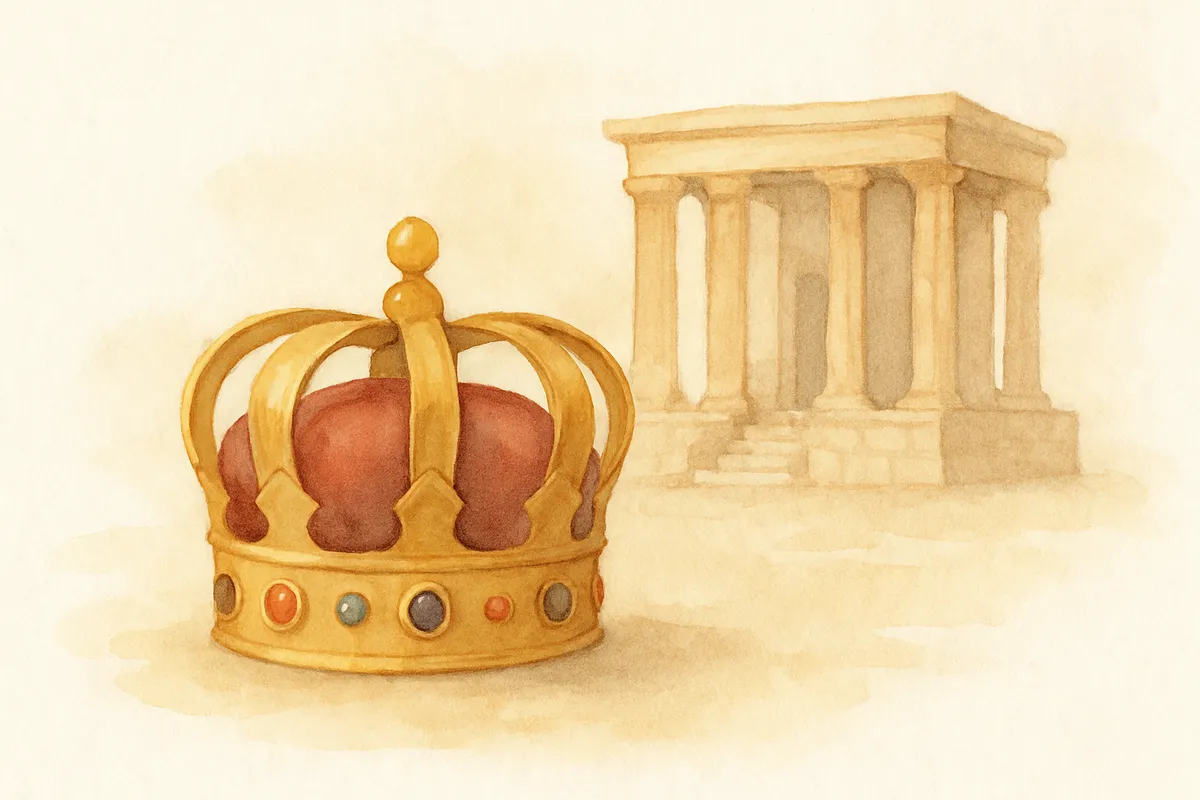
Herod was one of the most complex and morally paradoxical figures in late Second Temple Jewish history. Though remembered as a ruthless, illegitimate ruler who murdered Sages and even his own family, he also rebuilt the Beit HaMikdash (Holy Temple) into one of the most magnificent structures in the ancient world, leaving an enduring — and deeply ambivalent — legacy in Jewish tradition.
Key Takeaways
- Herod was of Edomite (Idumean) descent and was considered an illegitimate king, usurping the throne that belonged to the tribe of Judah.
- The Talmud praises Herod's Temple as breathtaking in its beauty, declaring it the benchmark for architectural glory.
- Herod rebuilt the Temple partly as an act of atonement after blinding the Sage Bava ben Buta and massacring the Sages.
- The Ramban interprets Herod's destruction of the Hasmonean dynasty as Divine punishment for their own usurpation of kingship.
- Miraculous weather during the Temple's construction was seen as Divine approval of the sacred work.
Herod's Identity and Illegitimacy
Herod (Hebrew: Hordos) was an Idumean (Edomite) who rose to power under Roman patronage. The Ramban on Genesis 49:10 explains his rise in the context of Jacob's blessing that kingship would remain with the tribe of Judah:
"Four sons of Matisyahu HaKohein Hashmonai, initiator of the Maccabean revolt, ruled Israel one after the other and all met violent deaths because they usurped the prerogative of Yehudah. In the end their entire lineage was extirpated by their Edomite servant Herod." [Ramban, Genesis 49:10]
The Ramban reads history as a two-stage tragedy:
- The Hasmoneans (Maccabees) sinned by taking the kingship for themselves, despite being Kohanim (priests), not from the tribe of Judah.
- Their punishment was destruction at the hands of Herod, their own Edomite slave — a profound historical irony.
Herod and the Sages — A Murderous Beginning
The Talmud in [Bava Batra 4a] records a remarkable story of crime and attempted atonement. Herod, fearing the Sages' opposition to his illegitimate rule, massacred them. He spared only one: Bava ben Buta, whom he blinded.
Later, disguised as a commoner, Herod tested Bava ben Buta by speaking disparagingly of Herod himself. Bava ben Buta rebuked him for cursing the king. Herod then revealed himself and asked what he could do to atone. Bava ben Buta counseled him:
"Send a messenger who will travel there [to Rome] for a year, and remain there for another year, and take yet another year to return. In the meantime, you can demolish the Temple and rebuild it." [Bava Batra 4a]
This clever advice solved a political problem — Herod feared Rome would not permit the rebuilding — while channeling his guilt into the greatest act of tikkun (repair) available to him.
The Temple's Unparalleled Beauty
Despite Herod's dark origins, the Talmud is unambiguous in its praise of the Temple he built:
"He who has not seen the Temple in its full construction has never seen a glorious building in his life. Which Temple? Abaye, or if you want, R. Hisda said: This refers to the building of Herod." [Sukkah 51b]
The Talmud records that Herod used alternating rows of marble and gold, and considered covering all the marble with gold — but the Sages advised against it, saying the marble, with its wave-like appearance, already evoked the beauty of the sea.
Divine Approval — Miraculous Rain
One of the most poignant proofs of Divine acceptance of Herod's Temple work appears in [Taanit 23a]:
"And so we found in the days of Herod, when they were busy building the Temple, rain would fall at night, and the next day, the wind would blow, and the clouds would disperse, and the sun would shine, and the nation would go out to their work, and they would know they were engaged in sacred handiwork."
The rain fell only at night — so as not to interrupt the holy work — and the sun shone during the day. The workers understood this as a miraculous sign that God endorsed their labor, even under Herod's reign.
Herod in Broader Torah Perspective
Herod represents a recurring Torah theme: the tension between a flawed human instrument and Divine purpose.
- His rise fulfilled the Ramban's reading of the curse upon the Hasmoneans for usurping Judah's kingship [Ramban, Genesis 49:10].
- His Temple building was an act of kapparah (atonement), yet the Temple he built was ultimately destroyed — suggesting that magnificent structures cannot substitute for moral and spiritual integrity.
- The Mishneh Torah [Hilchot Beit HaBechirah 1:17] reminds us that even the most glorious Temple is bound by Torah law — no stone may be demolished, no step built to the Altar — underscoring that the kedushah (holiness) of the Temple transcends any individual builder, even a king.
Herod's story is ultimately one of the most sobering in Jewish history: a man capable of building heaven on earth, yet also capable of destroying the human beings who inhabited it.
Sources
People Also Asked
Want to dig deeper?